
Menopause at Work: Where State Laws Stand in Q4 2026
Oct 28, 2026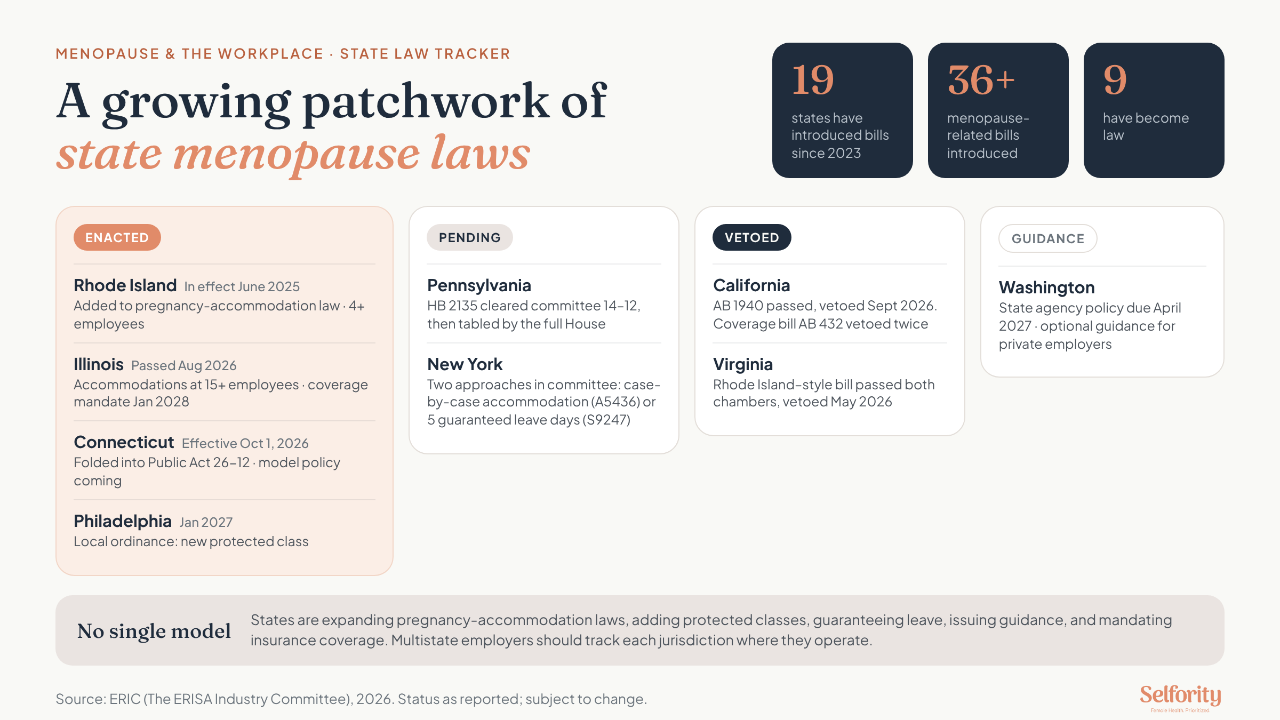
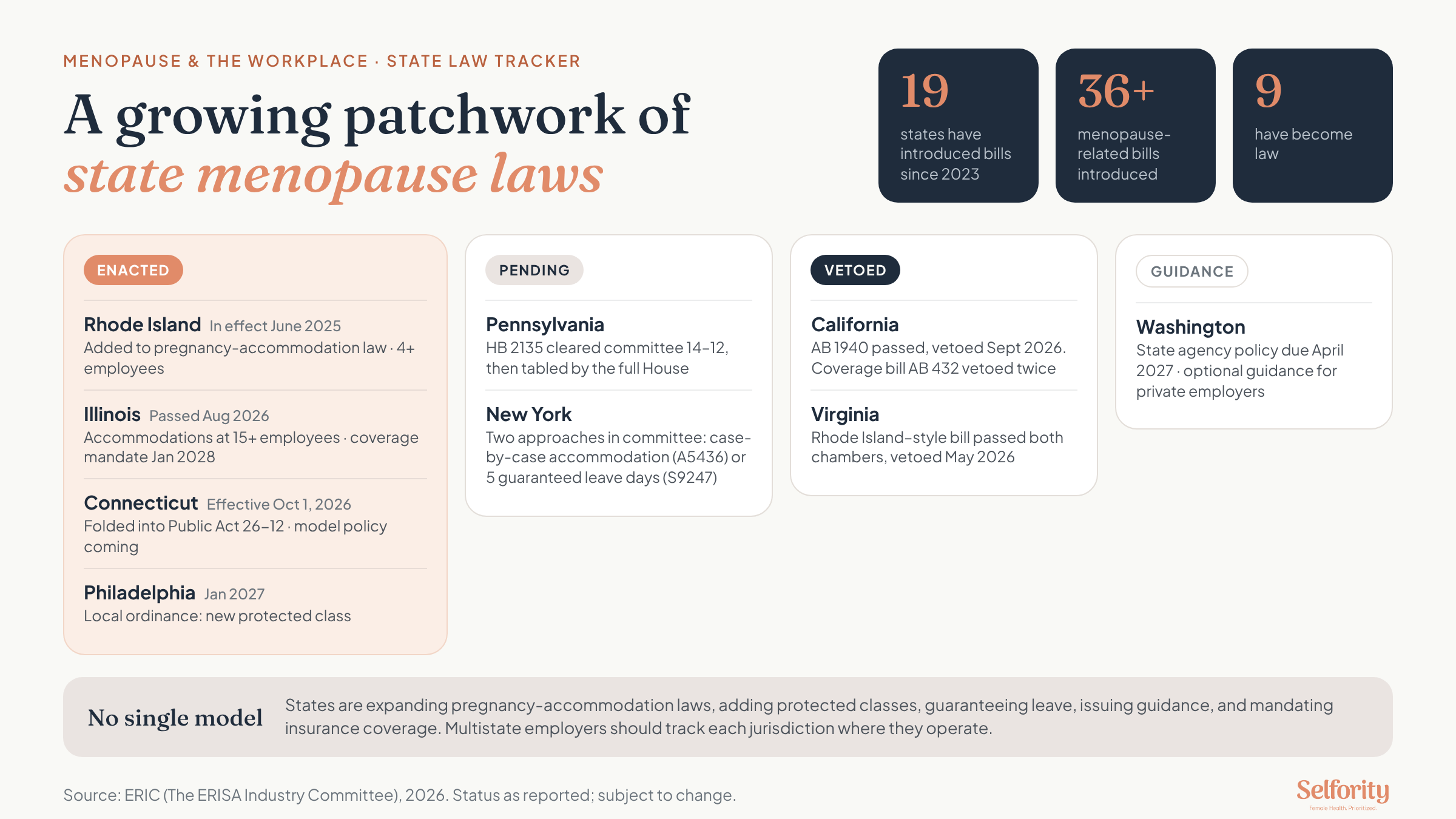
Menopause has become a rapidly growing area of state law in just the last couple of years. Since 2023, 19 states have introduced more than three dozen menopause-related bills, and nine have since become law. Illinois, Louisiana, Oregon, Washington, and New Jersey also require some insurance plans to cover menopause treatment in addition to the workplace requirements discussed below.
For multistate employers, this creates a growing set of rules that can differ drastically by jurisdiction.
What are the Current State and Local Menopause Policy Advances?
Rhode Island is the first state to enact such a law. Others have followed quickly, and many other states are working to advance policies.
Rhode Island: Enacted
- Effective since June 2025, the policy adds menopause-related conditions to the state’s existing pregnancy-accommodation law.
- Covers employers with four or more employees.
- Possible accommodations include: remote work, schedule changes, longer or more frequent breaks, time off for medical appointments, temporary transfers, light duty, and easier bathroom access.
- Employers cannot require leave if another reasonable change would work. They must also provide notice and post information about the law.
Illinois: Enacted
- The Menopause Equity and Care Act passed in August 2026. Beginning in January 2028, a separate provision will require state-regulated health plans to cover FDA-approved hormonal and non-hormonal treatments, including osteoporosis medication.
- Covers employers with 15 or more employees.
- The final law adds menopause-related conditions to the state’s pregnancy-accommodation law. It is narrower than the original bill because lawmakers removed a proposal to make menopause a separate protected category.
- Possible accommodations include: flexible schedules, modified hours, temperature-controlled workspaces, light duty, or job changes.
Connecticut: Enacted
- Most of the act’s provisions, including those listed in the next bullet, take effect October 1, 2026.
- The law adds menopause-related conditions to the state’s existing accommodation protections and directs the Commission on Human Rights and Opportunities to develop a model workplace policy and educational materials.
- Connecticut’s accommodation language didn’t advance as a standalone bill.
- SB 353 cleared the Labor and Public Employees Committee with a Joint Favorable report. Its text was folded into Public Act 26-12, the broader workforce bill Governor Lamont signed in May.
Philadelphia: Enacted
- At the local level, Philadelphia added menopause and perimenopause to its protected classes via an ordinance set to take effect in January 2027.
Pennsylvania: Pending
- HB 2135 would add menopause to state pregnancy-accommodation rules rather than create a separate protected category.
- Rep. Morgan Cephas introduced the bill in January with 21 Democratic co-sponsors. A House committee approved it 14–12 on September 29, but the full House tabled it the same day. The bill is out of committee, but not moving toward a vote. It is part of a broader package, “No Time for a Pause”, that includes HB 1345, a separate proposal to expand Medicaid coverage for menopause treatment.
New York: Pending
- Both A5436 and S9247 remain in committee: A5436 sits in the Assembly Governmental Operations Committee, and S9247 is in the Senate Labor Committee.
- A5436 would fold menopause into the state’s existing disability and pregnancy accommodation framework. This bill echoes the mechanisms Rhode Island, Illinois, and Pennsylvania use: employers accommodate an employee’s specific menopause-related needs case by case, with no guaranteed time off.
- S9247/A10296 guarantees a fixed benefit, at least five days of leave in any 12-month period for menopause symptoms, regardless of what accommodation an employee might otherwise need, and it directs the Labor Commissioner to develop workplace guidance and run a public-awareness campaign.
Washington: Under Guidance
- Governor Ferguson directed the state Women’s Commission to create an accommodation policy for state agencies and report on its progress by April 2027. The Commission must prepare optional guidance for other public and private employers. Private employers do not have to act, and no bill is pending.
- The state is developing a model that could shape future legislation.
California: Vetoed
- The Legislature passed AB 1940 on August 28, but Governor Newsom vetoed it in September, saying existing sex-discrimination law already provided protection and warning that adding new terms could create lawsuits without adding meaningful safeguards. California lawmakers have also rejected AB 432, an insurance-coverage bill Newsom vetoed twice over cost.
- AB 1940 would have added perimenopause, menopause, and postmenopause to the definition of “sex” under the state’s workplace discrimination law. It would have covered employers with five or more employees.
Virginia: Vetoed
- A bill (modeled on Rhode Island's measure) passed the House on February 17 and the Senate on March 5.
- Governor Spanberger vetoed it in May after lawmakers rejected her proposal to study the issue first.
What Should Employers Consider?
Workplace accommodation laws apply to every covered employer, no matter how the employer health benefit plan is funded.
Employers should consider state menopause coverage requirements when designing health benefit plans. State insurance mandates usually do not apply to self-funded plans governed by federal law, which cover many ERIC members.
More states are likely to act, but they are unlikely to follow one definitive policy model. Some may expand pregnancy-accommodation laws. Others may change discrimination rules, provide leave, issue guidance, or require insurance coverage.
Multistate employers should not expect a single national standard, but should track developments where they operate and prepare for the patchwork to grow.
Selfority tracks policy changes in real time, and ERIC will continue monitoring this patchwork. Subscribe to the Selfority Newsletter and follow us on LinkedIn to stay updated on significant changes as they arise.
The New Menopause Compliance Patchwork originally appeared on October 21, 2026, via ERIC.org. The national nonprofit organization exclusively represents the largest employers in the United States in their capacity as sponsors of employee benefit plans for their nationwide workforces.
Join our mailing list to receive the latest news and updates from Selfority.
We hate SPAM. We will never sell your information, for any reason.
Author