Menopause Treatments That Sound Medical, and What the Evidence Actually Says
Apr 14, 2026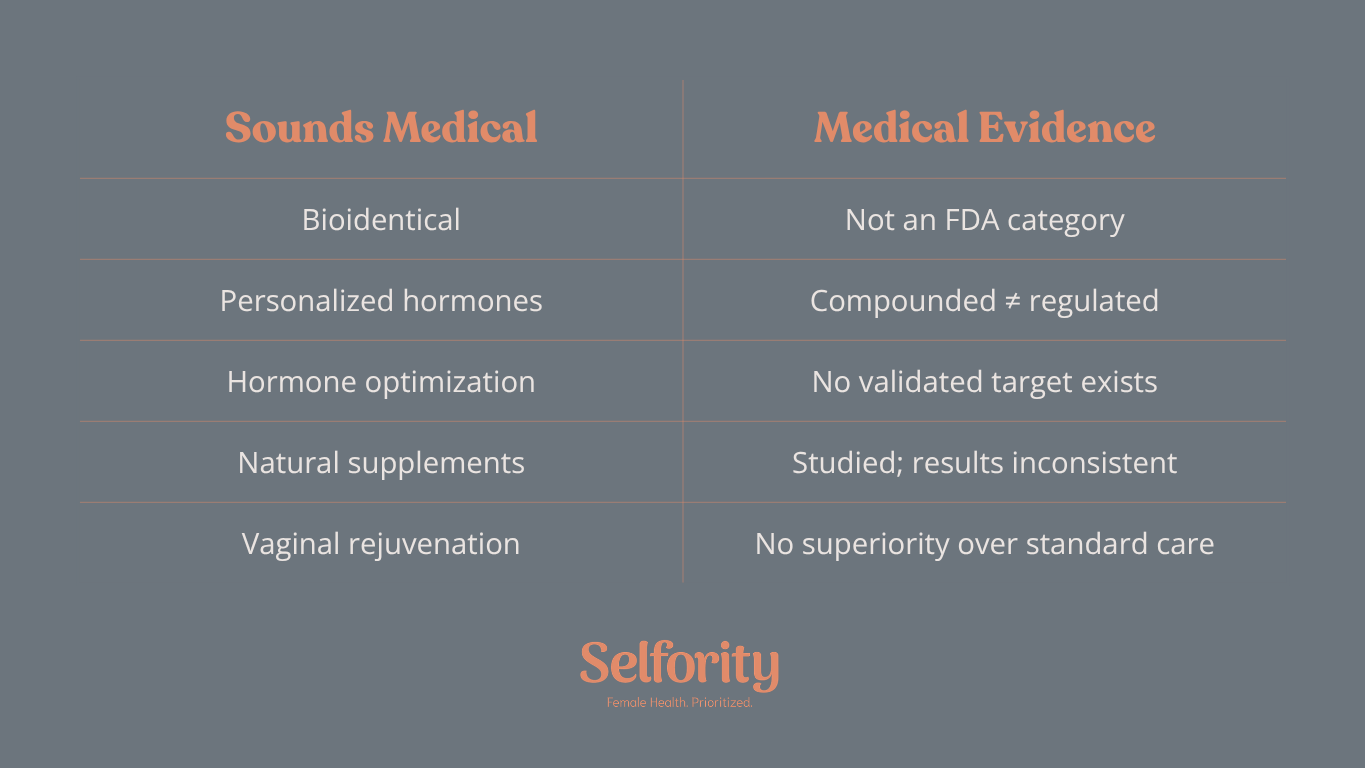
There's a moment many women describe — somewhere between the third sleepless night and the fifteenth scroll through a menopause wellness feed — when the search for relief has become desperate and you're willing to entertain anything.
You know the imagery. Women in linen, barefoot on stone floors, glowing. The message underneath is gentle and specific: your hormones are off. We can measure them. We can fix them. And the version of you that felt capable, rested, and like herself — she's accessible again, just a consultation away.
For women who have spent months feeling dismissed, confused, or quietly falling apart, that message doesn't land as marketing. It lands as finally being seen.
That's worth sitting with — because it explains everything.
Why the Menopause Marketplace Found You Before Medicine Did
Menopause has spent decades in a medical gray zone. Common, disruptive, physically significant — and chronically underdiscussed. For too long, women were told their symptoms were normal, which was used as shorthand for tolerable. Sleep problems were attributed to stress. Mood changes were labeled anxiety. Weight changes were tied to willpower. Appointments were short.
So women went looking elsewhere, and the wellness industry noticed. It didn't create menopause distress. It found it — and it responded with an ecosystem designed to meet the depth of that need.
That's not a conspiracy. It's a market. But it means the landscape women are navigating today layers real suffering with real gaps in care and a marketplace that understands how badly women want to feel better.
Wanting relief is not naive. It's human. But when the desire for relief is strong enough, the bar for proof can quietly shift. Something framed as individualized, natural, or "what your doctor never told you" doesn't register as risky. It registers as finally being honest.
What the Evidence Actually Says
This is where clinical clarity matters — not to dismiss women's experiences, but to protect them.
Compounded "bioidentical" hormones are one of the most misunderstood offerings in this space. The word bioidentical is molecular, not a marketing promise — it simply means the hormone molecule is chemically identical to what the body produces. Critically, FDA-approved hormone therapies are bioidentical. What distinguishes compounded versions isn't the molecule; it's the regulatory pathway. Compounded products are not reviewed by the FDA for safety, effectiveness, or quality before reaching patients. Research suggests that roughly 86% of women using them don't know that.1
Hormone pellets are small implants releasing hormones continuously over months. They are frequently marketed as steady and natural. The data tell a different story. In one observational study of 539 postmenopausal women, more than 57% of pellet users experienced side effects, compared with 15% of women using FDA-approved therapy.2 Abnormal uterine bleeding occurred in over half of pellet users. Average testosterone levels in the pellet group were around 194 ng/dL — far above the normal range of 15-70 ng/dL for women. There is no off-switch once a pellet is inserted.
Hormone testing via saliva panels is often positioned as the scientific backbone of individualized care. But menopause is not a steady state, and a single hormone snapshot cannot reflect it. In perimenopause, estrogen can swing from high to low and back within days. Major medical societies — including The Menopause Society and ACOG — consistently recommend treating menopause by symptoms, not hormone levels, once other conditions have been ruled out. There is no validated hormone "target." There is no number that tells a clinician when to start therapy or how much to prescribe.
Menopause supplements have surged in part because they feel accessible and low-risk. Many are marketed with ingredient lists designed to sound comprehensive: black cohosh, soy isoflavones, dong quai, maca, evening primrose. The 2023 position statement from The Menopause Society is direct: managing menopause symptoms with dietary supplements is complex and challenging because of limited trial data and no government regulation ensuring purity, potency, or safety. Independent testing has found dose variability, heavy metal contamination, and unlisted pharmaceutical ingredients in products sold as natural. "Natural" does not mean inert.
Vaginal laser treatments and peptide infusions are newer but follow the same pattern: marketed with compelling language, often sold in medical settings, priced at significant out-of-pocket cost, and lacking high-quality long-term evidence showing superiority over less expensive, well-studied options. The FDA issued a formal warning in 2018 regarding energy-based vaginal devices. For peptides and NAD+ therapies, major guidelines — including the Endocrine Society and The Menopause Society — do not list them as evidence-based options for menopause symptoms.
What Good Menopause Care Actually Looks Like
The most effective treatments for menopause don't tend to photograph well. FDA-approved hormone therapy for appropriate candidates. Evidence-based nonhormonal medications. Local vaginal therapies that are inexpensive, regulated, and supported by decades of data. They're not novel. But they work, and critically, they've been studied long enough to know their safety profile.
Good menopause care also starts with a real conversation. Not a saliva panel or a pellet protocol, but a physician who listens to what you're experiencing and helps you weigh options with full transparency about what is proven, what is promising, and what is, at this moment, simply expensive hope.
You deserve that distinction. You deserve to walk into a clinical conversation prepared, not because you've spent hours researching to protect yourself from a system designed to serve you, but because you're informed enough to ask the right questions and advocate for care that's actually grounded in evidence.
The Bottom Line
Menopause is not a problem that the right product will solve. It is a transition that deserves serious, evidence-based, individualized medical attention. The symptoms you're experiencing are real. The desire to feel like yourself again is completely reasonable. But the marketplace is not a substitute for medicine, and marketing is not the same as proof.
You are capable of navigating this. Knowing the difference between what is studied and what is sold is one of the most powerful tools you have.
Dr. Sarah Berg is a board-certified OB-GYN, Menopause Society Certified Practitioner, and founder of Selfority — a doctor-led menopause education platform built to give women the clarity they deserve.
Read the original piece in Unbiased Science.
Join our mailing list to receive the latest news and updates from Selfority.
We hate SPAM. We will never sell your information, for any reason.
Author